Why Industrial Wireless Fails In Real Environments
One of the biggest misconceptions in industrial wireless planning is assuming that acceptable signal strength automatically means reliable operational communications.
Veterans who worked through the paging era, early microwave deployments, ISDN rollouts, first-generation telemetry systems, and early industrial Wi-Fi deployments know this is not true.
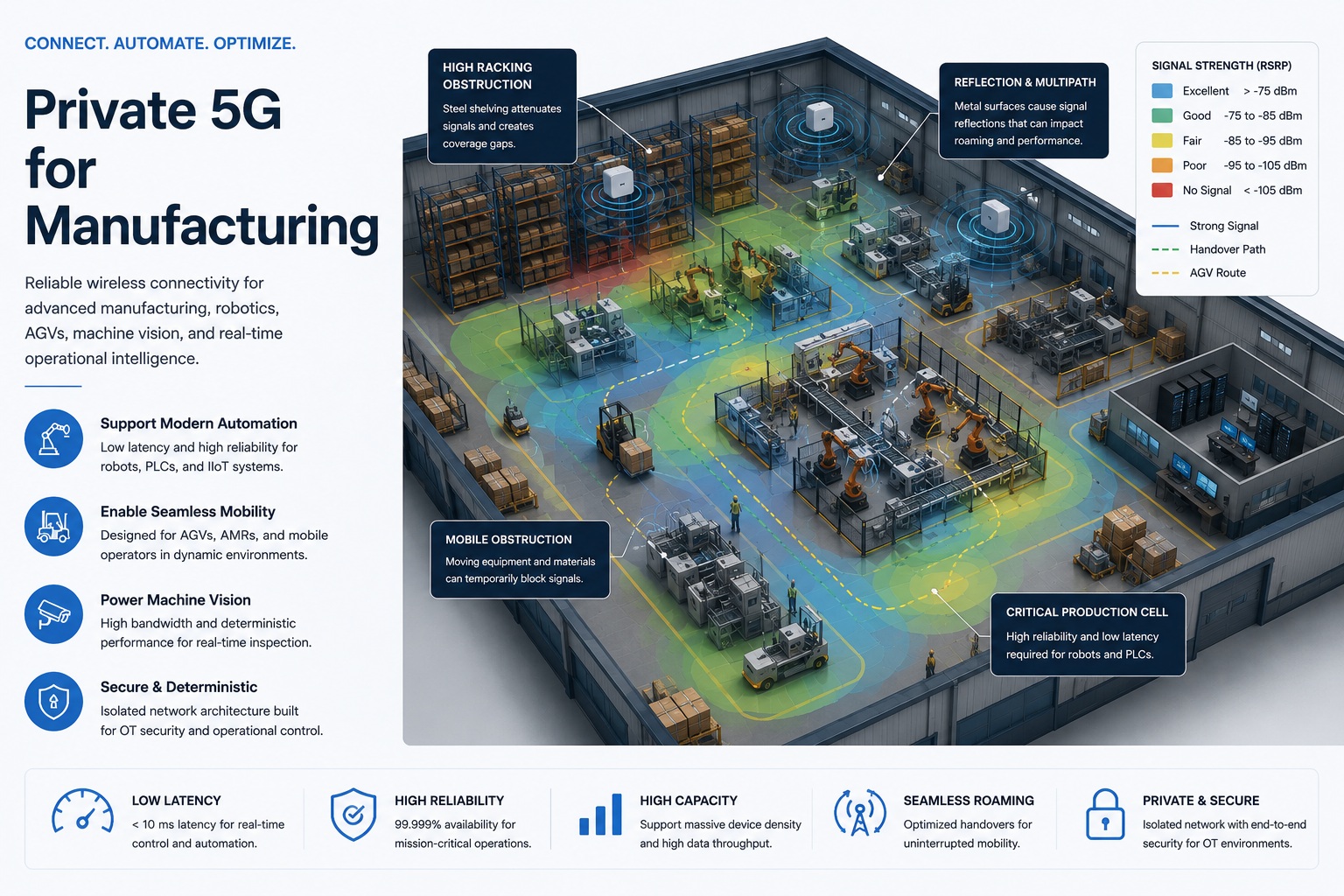
Many operational failures are caused by roaming instability, temporary RF shadowing, congestion during operational peaks, poorly modelled mobility transition zones, or reflective industrial environments that distort packet delivery behavior under load.
In warehouses, autonomous forklifts can temporarily block line-of-sight propagation paths. In substations, transformers and steel structures can alter coverage behavior dramatically. In manufacturing plants, reflective surfaces and moving machinery can create multipath conditions that appear stable during low activity periods but fail once production ramps up.
Real RF Engineering vs Generic Network Installations
The difference between a stable industrial wireless deployment and a problematic one is rarely the hardware itself. Most failures originate during planning.
A site survey performed while a logistics yard is partially empty may become invalid once containers are stacked six levels high. A warehouse heatmap captured before autonomous vehicle deployment may not reflect the actual roaming conditions devices experience during production operations.
That is why experienced RF engineers focus heavily on:
- Mobility transition behaviour
- Channel reuse planning
- Signal overlap integrity
- Roaming thresholds
- Dynamic obstruction analysis
- Noise floor variation
- Operational congestion windows
- Device density growth modelling
Industrial private 5G is not about placing radios around a building. It is about engineering predictable operational behaviour inside environments that constantly change throughout the day.
Lessons Learned From Earlier Generations Of Industrial Communications
Organizations that operated through the paging, narrowband radio, microwave, ISDN, early cellular, and first-generation industrial Wi-Fi eras learned an important lesson: communications reliability matters most during abnormal operational conditions.
Many systems perform adequately during low activity periods. The real test occurs during outages, congestion spikes, shift transitions, emergency response events, or high-density operational windows where every device begins competing for airtime simultaneously.
Private LTE and private 5G create the opportunity to finally engineer industrial wireless environments intentionally rather than layering operational systems on top of fragmented legacy connectivity.
But achieving that reliability still requires disciplined RF engineering, physical environment analysis, operational workflow modelling, and long-term capacity planning.